



VO2 Max Testing
The VO2 Max test gives you the best possible measure of your overall cardiovascular fitness and efficiency.

VO2 MAX Testing
The VO2 Max test gives you the best possible measure of your overall cardiovascular fitness and efficiency.

What is VO2 Max testing?
VO2 Max is a measure of your aerobic capacity.
It’s shorthand for the Maximum (Max) Volume (V) of Oxygen (O2): the amount of oxygen your body can process when you are exercising at the limits of your ability.
The higher the amount of oxygen you can process, the fitter you are and the better adapted to cardiovascular training.
What can a VO2 Max test tell me?
A VO2 Max test provides you with information about your cardiovascular fitness. The data will include:
- Your VO2 Max score: the gold-standard measure of aerobic capacity
- Personalised training zones
- Carbohydrate vs fat burn at each heart rate intensity
- An understanding of your overall cardiovascular fitness
How does VO2 Max testing work?
A VO2 Max test measures how much oxygen you breathe in and use as you exercise. The more oxygen you can use, the more efficiently your cardiovascular system is working.
The VO2 Max test works by measuring how much oxygen and carbon dioxide you breathe in and out while exercising. During the test, the intensity is ramped up. As the intensity increases, you will breathe harder, requiring more oxygen.
The amount of oxygen we have the capacity to take on, transfer to the bloodstream, and use to generate energy, varies depending on our cardiovascular fitness. In general, the more high intensity or longer exercise sessions you do, the greater the volume your body will allow.
There comes a point where you can increase the exercise intensity (for a short time) but the body will simply not process any more oxygen. This is the point at which you’ve reached your VO2 Max.
What is VO2 Max testing?
VO2 Max is a measure of your aerobic capacity.
It’s shorthand for the Maximum (Max) Volume (V) of Oxygen (O2): the amount of oxygen your body can process when you are exercising at the limits of your ability.
The higher the amount of oxygen you can process, the fitter you are and the better adapted to cardiovascular training.
How can a VO2 Max test tell me?
A VO2 Max test provides you with information about your cardiovascular fitness. The data will include:
- Your VO2 Max score: the gold-standard measure of aerobic capacity
- Personalised training zones
- Carbohydrate vs fat burn at each heart rate intensity
- An understanding of your overall cardiovascular fitness
How does VO2 Max testing work?
A VO2 Max test measures how much oxygen you breathe in and use as you exercise. The more oxygen you can use, the more efficiently your cardiovascular system is working.
The VO2 Max test works by measuring how much oxygen and carbon dioxide you breathe in and out while exercising. During the test, the intensity is ramped up. As the intensity increases, you will breathe harder, requiring more oxygen.
The amount of oxygen we have the capacity to take on, transfer to the bloodstream, and use to generate energy, varies depending on our cardiovascular fitness. In general, the more high intensity or longer exercise sessions you do, the greater the volume your body will allow.
There comes a point where you can increase the exercise intensity (for a short time) but the body will simply not process any more oxygen. This is the point at which you’ve reached your VO2 Max.
What will happen during the VO2 Max test?
When you arrive at the lab, we’ll first ask you some questions about your health and wellbeing, and there will be an opportunity for you to ask any questions.
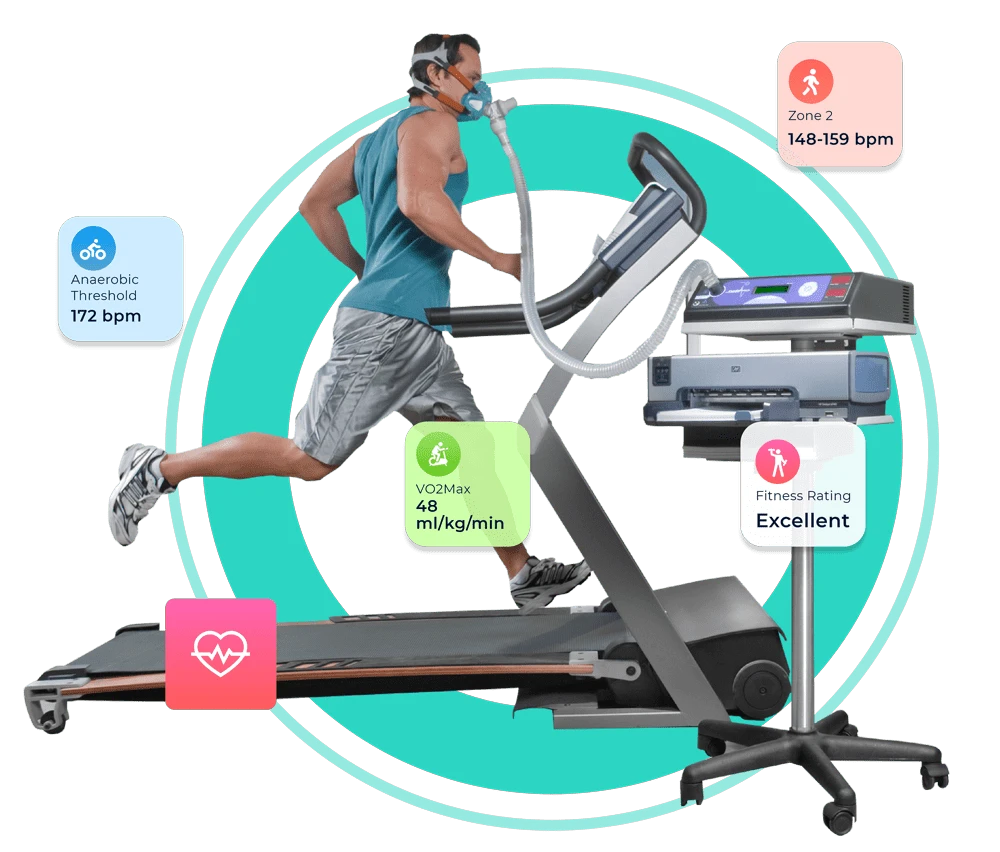
You should come to your test ready for exercise. We will put a mask over your face, which will ensure that all your exhaled air goes into a tube and into the machine. This is used to measure your oxygen and carbon dioxide output as you complete the test.
You can choose to complete the VO2 Max test on either the treadmill or the Watt bike. As you start to exercise, we will steadily increase the intensity, while keeping a close eye on your data. A VO2 Max test requires you to push yourself, so be ready to work hard! When we have sufficient data (which usually takes somewhere between 10 and 20 minutes) we will give you time to cool down.
Then, we will walk you through the results of your test and how you can use the data to maximise your training.
What do I get at the end of the test?
We will provide you with a detailed report showing you how your body reacts to exercise, and we will help you understand your results. You will leave you appointment knowing:
- Your VO2 Max score: the gold-standard measure of aerobic capacity
- Personalised training zones
- Carbohydrate vs fat burn at each heart rate intensity
- An understanding of your overall cardiovascular fitness
How long is a VO2 Max test?
The VO2 Max test itself takes up to 20 minutes, but you should allow a full hour for your appointment. It will take some time to get the equipment set up, for us to fit your mask, and to complete the questionnaire and health screening. After the test has been completed, we will spend some time going through your results. This is to ensure you leave the lab with a full understanding of your data and how to apply it to your training.
What equipment is used for a VO2 Max Test?
You can choose to perform the VO2 Max on either a treadmill or a stationary bike. You will be fitted with a face mask that measures the composition of the air you exhale and a heart rate monitor chest strap.

Why would I want to do a VO2 Max test?
The VO2Max test is a great way to check in on your cardiovascular fitness.
The VO2 Max and the associated report can help a lot with training for cardiovascular type events, such as marathon and triathlon training. You can get a real understanding of how fit you are, how much of a journey you have to go on, how safe it is to push to certain levels of effort and a whole lot more.
VO2Max is also highly correlated to cardiovascular fitness and longevity. Studies have repeatedly shown that a higher VO2max is associated with lower mortality from all causes.
There also might be situations where you need a VO2Max score for your job. Certain professions like working on an oil rig, or becoming a diving instructor, will require a minimum VO2Max score which is independently tested – we are able to perform this test and provide you with this result.
How do I read my VO2 Max results?
The first part of your VO2 Max results looks like this. Here you can see a number of things:
You can see in the first row what heart rate you were at at the start of the test, and when you hit your Aerobic Threshold, Anaerobic Threshold, and your actual measured peak heart rate on the test. It also projects what your peak heart rate would be when you hit your VO2 Max.
The second row shows the Volume of Oxygen being processed by your body when you hit each of the milestones described above.
The last row tells you how many calories per hour you are burning at each of the milestones.
| VO2 MAX TEST RESULTS | |||||
|---|---|---|---|---|---|
| Start | Aerobic Threshold | Aerobic Threshold | Peak | Extrapolated VO2 Max | |
| Heart rate | 78 | 126 | 160 | 175 | 189 |
| VO2 (ML/KG/MIN) |
5.3 | 23.1 | 34.0 | 43.7 | 52.4 |
| KCALS/HR | 156 | 678 | 1,028 | 1,325 | 1,587 |
| VO2 MAX TEST RESULTS | |||||
|---|---|---|---|---|---|
| Start | Aerobic Threshold | Aerobic Threshold | Peak | Extrapolated VO2 Max | |
| Heart rate | 78 | 126 | 160 | 175 | 189 |
| VO2 (ML/KG/MIN) |
5.3 | 23.1 | 34.0 | 43.7 | 52.4 |
| KCALS/HR | 156 | 678 | 1,028 | 1,325 | 1,587 |
The main graph of your VO2Max test will show you how much fat and how much carbohydrate you are burning at different heart rates.
The purple bars are fats, the yellow bars are carbohydrates. As you can see, as you increase heart rate you are progressively burning more calories, and more of them are from carbs. By analysing your results, we can suggest the most efficient training zones for your body. This will help you to get the most out of your cardio training.

How intense is the test?
The test will take you very close to your maximal intensity at the end. It will be very strenuous, and you will also likely get very sweaty.
Returning to the office immediately afterwards might not be a great idea, but if you do have somewhere to be, please do make use of our shower facilities afterwards to shower off. Please bring your own towel and toiletries if you’d like to do this.
How much does a VO2 Max test cost?
We keep our pricing as easy to understand as possible. For a full schedule of prices for all tests/scans and memberships, please click here. You can book the VO2Max test as a stand-alone test for £169.
Who can take a VO2 Max Test?
Unfortunately, because of its intensity, a VO2Max test is not suitable for everybody. Before booking your test, please review the following list of exclusion criteria to ensure you are eligibile. If you have a condition on this list, you will need a doctor’s letter that specifies you are able to partake in a maximal exercise test.
Aside from these conditions, however, the VO2 Max is not for the faint of heart, and we would only suggest it if we think the stats would really benefit you. If you would like to understand more about your cardiovascular system, and what the most ideal range is for burning fat, then you should consider our FATMAX test instead.
If you answer yes to any of the questions below, the VO2 Max test may not be performed. If in doubt – please email us, or use the WhatsApp contact button in the bottom right of each page.
Do you have any diagnosed cardiovascular disease, including cardiac, peripheral vascular, or cerebrovascular diseases?
Do you have any diagnosed pulmonary disease such as Chronic obstructive pulmonary disease, asthma, interstitial lung disease, cystic fibrosis
Do you have any diagnosed metabolic disease, including Diabetes mellitus (type I or II), thyroid disorders, renal or liver disease
Have you experienced unusual pain or discomfort in your chest (pain due to blockage in coronary arteries of the heart)?
Have you experienced unusual shortness of breath during moderate exercise (such as climbing stairs)?
Have you had any problems with dizziness or fainting?
When you stand up, or sometimes during the night, do you have difficulty breathing?
Do you suffer from swelling of the ankles (ankle edema)?
Have you experienced a rapid throbbing or fluttering of the heart?
Have you experienced severe pain in your leg muscles during walking?
Has your doctor told you that you have a heart murmur?
Have you felt unusual fatigue or shortness of breath with usual activities?
Are you taking any medications which affect your heart rate or breathing?


Ready to get started?
Find out which plan is best for you.