



DEXA Scans
The foundation of health and fitness testing at My Vital Metrics is the DEXA Scan: the gold standard test for Body Composition Analysis, Body Fat Measurement, and Bone Density Analysis.

DEXA Scans
The DEXA Scan is the foundation of our testing services at My Vital Metrics offering the gold standard in Body Composition Analysis, Body Fat Measurement, and Bone Density

What is a DEXA scan?
The DEXA scan is the gold standard test for body composition and bone density measurement. The scan uses low-dose X-rays to assess your body composition, bone strength, and bone density.
A DEXA body composition scan allows you to see exactly how much fat, muscle, and visceral fat you have. It will also show you the distribution of muscle and fat across your body, point to associated risks or hormonal issues, and identify any muscular imbalances.
What is a DEXA scan used for?
With the results of a DEXA Scan, you can create highly individualised workout and nutrition training plans by better understanding your body composition. Muscular imbalances, body fat composition, and bone density can all be used to target your training and boost results. Learn more about how to put your DEXA scan into action on our blog.
Our scans are different to a DEXA you might receive from a hospital or private medical facility. We use full body scanners at our London and Manchester Labs, which allow you to get an overall picture of your body composition. Medical scans usually provide very high resolution DEXA scans focused on one area to measure bone density for medical purposes, not fitness.
Unsure whether a DEXA Scan is right for you? Get in touch and our experts will assess your unique needs
What information can I get from a DEXA scan?
DEXA for Body Composition
Our DEXA scan for body composition will tell you your:
- Total body fat percentage and overall fat mass
- Visceral fat
- Fat distribution
- Muscle mass
- Muscle distribution
- Calculated Resting Metabolic Rate (RMR)
- General indication of bone density
DEXA for Bone Density
Our DEXA scan for bone density will provide:
- A high-resolution bone density scan, focusing on your hip and spine
- The T-score for each area (used for diagnosis by a specialist)
- Recommendation to raise with GP if out of range
DEXA for both Bone Density & Body Composition
You can get both scans done at the same appointment. You will get all of the metrics listed above. It will take another 10 minutes on the table, and a slightly longer appointment (by about 15 minutes). When you book your DEXA scan, select "DEXA Composition Plus" followed by "Bone Density Add On".
How does a DEXA scan work?
A DEXA scan uses low-dose X-ray beams to create an image of your body. The scanner passes a small amount of two different X-ray beams through the body, and these are absorbed or pass through the body in known quantities. Different amounts of the first beam will be absorbed by fat and by muscle, and the second beam will be absorbed by the skeleton. By measuring the amount of each beam which makes it through to the sensor on the other side, we can accurately determine how much fat, muscle, and bone there is in that part of the body.
Is a DEXA scan safe?
DEXA Scans are considered very safe. The radiation is so low that we (the operator) do not leave the room while it is operating. The radiation from 1 DEXA scan is about the equivalent to that of a 1-hour flight, or from eating a 120g bag of brazil nuts. Our DEXA scanners are regularly checked and calibrated to ensure that this remains the case. There is absolutely nothing to fear from taking a DEXA scan. We limit the number of scans a person can take in a year to 6, with individual scans being taken no less than 6 weeks apart.
Do I need a referral for a DEXA scan?
Yes, the legislation changed at the end of 2024, and now all DEXA Scans require a referral from a medical professional. You can supply your own if you have one, or else we can seamlessly have our dietician review your medical information and provide one for a low fee. If our dietician does refer you, that referral will be in place for 1 year before it needs review.
How does the referral process work for a DEXA scan?
From July 1st 2025, when you purchase a DEXA scan from us, the system will check if you have a referral in the system. If you don’t, it will require you to select a referral from our own dietitian for a small fee. You will add this to your booking, and will receive a medical information form to fill in and sign. Our Dietitian will then review the information provided and determine what body composition service would be most appropriate, and issue a referral for that. If they do refer for DEXA, this referral will last for 1 year, so the next time you book a DEXA within this time, you won’t have to repeat the referral process.
What is the Dexa Scan procedure?
Body Composition DEXA Scans
Click the image below to download a sample report

When you arrive at the lab, we’ll first ask you some questions about your health and wellbeing, and there will be an opportunity for you to ask any questions.
During your DEXA Scan, you may be asked to undress to your underwear and remove all jewellery/watches. If light clothing is worn with no metal in it, you may be able to remain clothed. A hospital gown can be provided if needed. Bras with underwires will also need to be removed.

Bone Density DEXA Scans
Click the image below to download a sample report

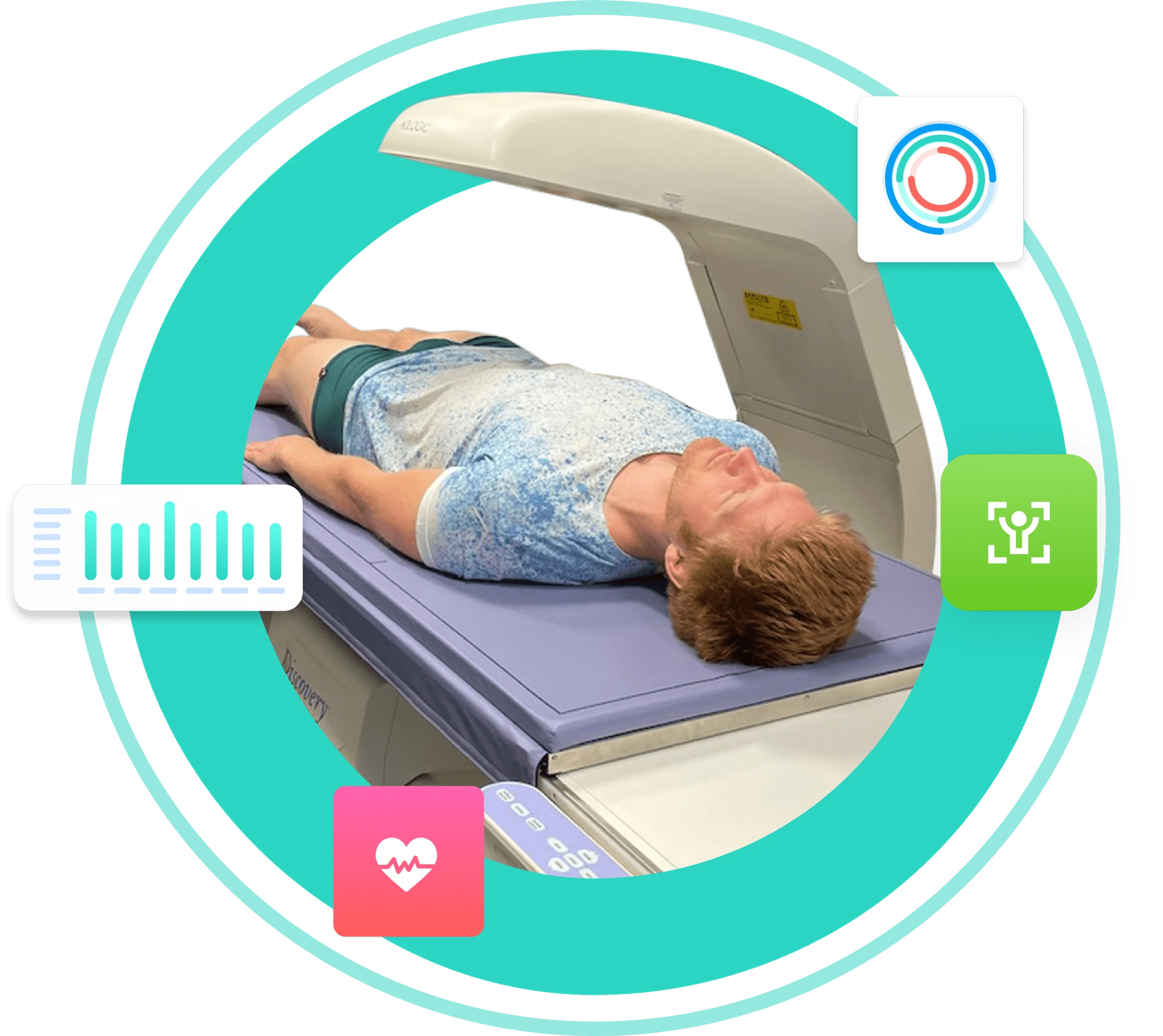
The DEXA technician will position you lying face-up on the scanner, ensuring that you are evenly spaced and within the limits of the scan area. They will also lightly secure your feet to each other so your legs can’t swing. When the scan is operating, the receiver arm will pass over your body in three ‘sweeps’, and will gradually build up a picture of you. It is important that you are very still while the scan is happening to ensure the best quality image. We also ask that you don’t talk. Once the scan is over, the technician will tell you it’s ok to get up and dress once again. The scan will take approximately 4 minutes to complete.
What information do I get after the scan?
Our expert technicians will walk you through how to read your Dexa Scan results, making everything really clear and easy to understand. After the scan, the technician will provide you with a multi-page report, and will walk you through some of the key points. You’ll be given detailed information about your bone density and body composition. Your trainer can advise you on how best to take advantage of this information, and help you to work into your training and nutrition plan. Read more in our fitness and nutrition blog about Understanding Dexa body composition results, or how we turn your Dexa Scan results into an action plan.
How much does a DEXA Scan cost?
When you come to the My Vital Metrics body composition lab, you don’t just get the scan. You also benefit from our team’s years of experience and have an expert technician walking you through the key points of your report. A one-off body composition DEXA scan costs £169, and a bone density scan can be added for £70.
Measuring body composition:
BIA/Bioimpedance
This method, most commonly found on gym floors or even in people’s bathroom scales, passes a small current through your body. It is predicated on the idea that water and fat will impede that electrical current at different rates. Among the problems found is that levels of hydration and numerous other factors influence this. The machines occasionally do produce meaningful results, but any individual’s readings should be calibrated against DEXA to determine their validity. They are nevertheless very good at breaking down the Lean Mass from a DEXA scan, into Intracellular Water, Extracellular Water and Total-Body Water, and splitting out from this Skeletal Muscle Mass.
Read more in our blog about the differences between Bioimpedance scales and Dexa Scans in our blog
Measuring body composition:
Skinfold calipers
Skinfolds, aren’t terrible as a body fat measurement. They have been shown to be reasonably accurate when in the hands of a trainer who has performed literally thousands of skin folds and can accurately find the right sites. But skin folds suffer from models once again. What if you’re a person who disproportionately puts fat on in one of the sites not measured? It throws the whole model out.
Skin folds can never tell you about imbalances, nor about site-specific muscle gain/loss.
Are there alternative ways to measure my body composition?
DEXA Scanning is the Gold Standard in body composition analysis and body fat measurement. No other method comes close to its consistency, ease of application and specificity. DEXA is also the only body composition measurement which will give you accurate fat mass, fat-free mass and bone mass, not just overall, but in each part of the body. This means that it can double as a measure of how recovery from injury is going, or detect imbalances between the left and right sides. It is also the only measurement which can give an indication of visceral fat – this is the fat which sits around the organs. This type of fat is appearing regularly in recent research as being an indicator for a range of health conditions.

3D Body Scanning & Mapping Included
Your DEXA Scan Package with My Vital Metrics Includes 3D Body Scanning & Mapping through BodyGee. – The leaders in 3D Body Mapping Technology. Your 3D body scan complements the DEXA results by allowing you to track your progress and get detailed insight into your body measurements from every angle.
Body Mass Index (BMI)
This is the most commonly used body composition measure in the medical profession. It’s a simple height and weight calculation. In anybody who has never seen the inside of a gym this might be ok. But once you’ve done any kind of heavy lifting it will cease to be relevant.
Other Frequently Asked Questions about DEXA scanning
Got more questions about DEXA? Maybe some of the below will help you to understand more deeply the report, and the procedure. If you’ve any questions however, please do feel free to email us, or use the WhatsApp button in the bottom right hand corner of the screen to get in touch.
Is a DEXA scan safe?
A DEXA scan is considered very safe. The radiation is so low that we (the operator) do not leave the room while it is going on. The radiation is about the equivalent to a 1-hour flight.
Does a DEXA scan use radiation?
Yes, a DEXA scan uses X-ray radiation to create the image. The radiation dose is very low, about the equivalent of a 1-hour flight.
We ask that you wait 2 months to get a DEXA scan after having any other X-rays (aside from dental X-rays). We will ask you about X-rays during our referral process, alongside your medical history. If a referral is granted, this will be based on the information provided, including whether you’ve had any X-rays recently or have any planned.
How long does it take to get DEXA scan results?
Results are instantaneous, and we will discuss them with you in depth at the same appointment.
Are DEXA scan results ever wrong?
Like any testing modality, preparation is important to the accuracy of the results. We will ask you to be at least 4 hours fasted, and to be normally hydrated (so no training beforehand). If you are careful with these preparations, DEXA is the most accurate and reliable and repeatable measure available. DEXAs are considered accurate to within 1% of the actual figures.
Can I have a DEXA scan with a pacemaker?
Yes, you can still have a DEXA Scan, but we will see the pacemaker on the scan, and it might mean we are unable to use some of the results (e.g., bone mass) unless we know the known weight of the pacemaker.
What is BMD in a DEXA scan?
BMD is Bone Mineral Density. It is a measure of how dense your bones are. It is measured in g/cm2. The three measures of bone health are:
- Area: how big your bones are overall
- BMC (bone mineral content): how heavy your bones are
- BMD (bone mineral density): calculated from the first two measurements and predicts how strong your bones are overall.
What is a DEXA t-score?
The T-score is a statistical measure to tell you how far you are from the ‘normal’ person. When you get a DEXA scan, the T-score is most commonly used to refer to your bone density. This measurement compares your bone density to that of a healthy 30-year-old white female. If you have a T-score of 0 this means that your bones are exactly the same density as that 30-year-old. If you have a T-score of -1, it means your bone density is 1 standard deviation less than this healthy adult.
If, when getting the Clinical bone density scans of your hip and lumbar spine, your T-score is between -1 and -2.5, this is defined as Osteopenia. If it is -2.5 or less, this is defined as Osteoporosis.
My Vital Metrics will not comment too much on your bone densities beyond what the report says, as we are not medical professionals, and the scan we do for whole body composition isn’t the ideal scan to identify any condition. However, if our composition scan shows a very low T-score, we might advise you to verify with a clinical bone density scan, and if this confirms low-bone-density, that you see your GP about it.
How much does a Dexa scan cost?
A one-off body composition DEXA scan costs £169, and a clinical bone density scan can be added for £70. Our DEXA scans are available at both our London and Manchester labs, and can be booked here.
What is a DEXA scan used for?
In their diagnostic context, DEXA scans are used to measure bone density and to diagnose conditions such as osteopenia and osteoporosis. More widely, they are also good for measuring the amount of bone, fat, and lean mass a person has. Here at My Vital Metrics, we use the DEXA scan in both ways: to assess bone health and to accurately measure body composition, including body fat, lean mass, and visceral fat.
Can a DEXA scan detect cancer?
No, the likelihood of a DEXA scan picking up any cancers is minimal. The DEXA is a whole body scan, which doesn’t work at an appropriate resolution to identify cancer.
Can a DEXA scan detect arthritis?
No, the resolution of the scans we use cannot detect arthritis.
Can a DEXA Scan show fractures?
Most fractures are very subtle and require a high-resolution scan of the fractured area in order to identify them. We use a whole body DEXA scan, and this cannot identify fractures.
Can I drink milk before a DEXA scan?
We usually ask you to fast from food for at least 4 hours before your scan and to be properly hydrated. While you can technically eat and drink anything you like before a DEXA scan, most foods will be added to your ‘lean mass’ figure. Therefore, fasting beforehand will help to give you the most accurate body composition result possible. Alternatively, as long as you keep things consistent between scans, you should still be able to track any changes.
How often should you have a DEXA scan?
We need to keep a minimum of 2 months between DEXA scans. Outside of this, the frequency of your visits will be up to you. We would suggest that you come in when you think you have seen a change in your body composition, or you are about to change up your training or your diet – e.g., when moving from a cutting phase to a bulking phase or vice versa.
How do I read a DEXA scan report?
We will walk you through the DEXA report and explain all the important parts for your particular circumstances. We will then email you a summary of our findings, as well as the report, so you don’t have to guess at what the figures all mean. You can read more about how to interpret a DEXA scan report on our blog.
Related Blogs


Ready to get started?
Find out which plan is best for you.