




What is Hyrox? Everything You Need to Know
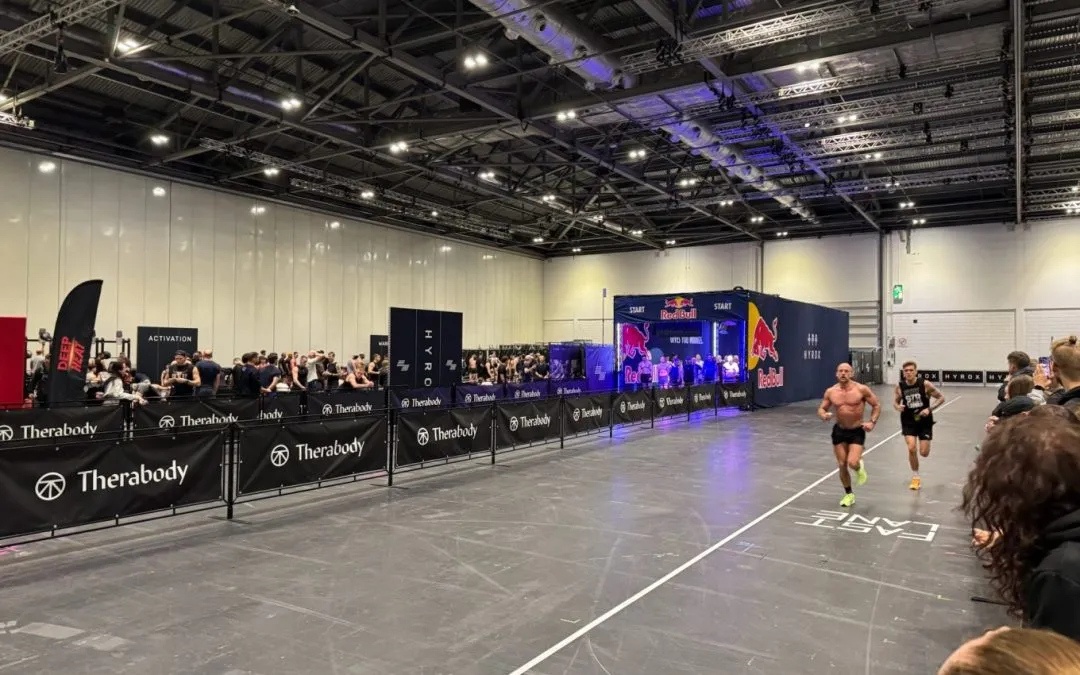
What is HYROX?
HYROX was created in 2017 by former Olympic gold medalist Moritz Fürste and experienced sports event organiser Christian Toetzke. Their vision was to design a standardised fitness race that would bridge the gap between endurance running and functional strength work.
The first event took place in Hamburg, Germany, and since then, HYROX has exploded in popularity, now held in more than 65 countries and attracting over 200,000 participants annually. It’s often referred to as “the World Series of Fitness Racing” due to its consistency, global reach, and growing competitive community.
In recent years, HYROX has earned a reputation as one of the most accessible yet challenging competitive fitness events in the world.
What sets HYROX apart from other fitness competitions, like CrossFit or obstacle course races, is its unique but consistent structure. The standards for each race are the same everywhere, meaning athletes can directly compare their times with competitors around the world.
What is a HYROX competition?
The HYROX race format is simple but challenging. HYROX is structured in a way to simultaneously test a competitor’s endurance as well as their mental and physical strength. Every participant completes eight 1 km runs, and after each run, they face a functional fitness station. The stations are always in the same order, so athletes can train specifically for what’s coming.
A HYROX competition occurs over multiple days, typically a full weekend. The competitors are given start waves and set dates and times based on the category they choose to compete in.
HYROX offers divisions so athletes of varying abilities can compete. There’s the Individual Open category, designed for people who want to test themselves without elite-level weights or expectations, and the Individual Pro category, where weights are heavier and the competition is stiffer. There’s also the Doubles category, where two people (either of the same gender or mixed) share the stations but run together. This can be a great option if you want to experience the race with a partner and break up the workload.
Amongst competitors, the Top 3 for each event and age category will be rewarded with a podium finish and a race flag.
A unique but set standard for HYROX is that it takes place indoors, in large exhibition halls or arenas. This ensures that all competitors face the same conditions: no mud, no weather factors, just you, your fitness, and the race ahead. The atmosphere is electric music pumping, spectators cheering, and athletes from all over the world collectively pushing themselves to their limits. Events are designed to be both a personal challenge and a celebration of the fitness community.
What is HYROX training?
Typically, HYROX training includes:
- Running workouts to build stamina and speed for the repeated 1 km runs.
- Strength and conditioning sessions focusing on the specific movements used in the race: sled pushes/pulls, rowing, burpees, lunges, farmer’s carries, wall balls, and ski erg.
- Circuit or interval training to improve your ability to recover quickly between intense efforts.
- Technique practice to make sure you move efficiently and avoid wasting energy.
- Mobility and injury prevention work to stay healthy through consistent training.
Who can do HYROX?
Almost anyone can do HYROX! It’s designed to be accessible for a wide range of people, from complete beginners to seasoned athletes. If you’re at least 16 years old, physically able to run and do basic functional movements like lunges, burpees, sled pushes, and rowing, you can join in.
An introduction to the 8 HYROX race stations
SkiErg

The race starts with a 1 km run, followed by a 1,000-meter SkiErg, an upper-body and cardio challenge that mimics Nordic skiing. Mostly upper body and core, but your legs help too. Smooth rhythm is everything, and it is important at this point not to waste energy. It is common for people to go too hard out of the blocks and “blow up” on the SkiErg. Remember this is the very first station of 8 total—keep a smooth rhythm, leave some energy in reserve.
Sled push

Now it gets brutal. The sled push is 50 metres total (4 x 12.5m lengths), with heavy weights depending on your division. This is typically one of the harder stations for lighter or more aerobically strong competitors. Get low, drive through your legs and shoulders, pushing hard and taking scheduled breaks when needed. Legs, shoulders, lungs all on fire. You’re using low upright handles to drive the sled forward. Grip the handles, dig in, and don’t give up.
Sled pull
Same sled, different pain. You drag the sled backwards by pulling on a rope, again over 50 metres in total. This station predominantly works your back, biceps, and legs. Technique matters here; focus on sitting low, staying grounded, and keeping the tension steady. It’s typically best to break this movement down into smaller distances and rest when needed.
Burpee broad jumps

[Photo by Alexandre Ricart on Unsplash]
After that is 80M of burpee broad jumps. Just like it sounds, the competitor drops for a burpee, then jumps forward as far as they can. Repeat until you’ve covered 80 metres. No equipment here, just your body and the floor. This one breaks a lot of people and is very challenging based on the effect this exercise will have on elevating your heart rate, especially mid-race.
Rowing

Then comes the rower. A standard Concept2 rowing machine. Similarly to the SkiErg, competitors are required to do 1000 metres before progressing. Legs, core, arms—this station is a full-body movement. It’s not as brutal as some of the other stations, but at this point, your lungs and body will appreciate the active recovery. The key is keeping a consistent stroke and not rushing it.
Farmer’s carry
Up next is the farmer’s carry. You pick up two heavy kettlebells (one in each hand) and carry them for 200 metres. Sounds simple, but your grip, traps, and forearms can fatigue surprisingly fast. You are allowed to drop them to take a break if required.
Sandbag lunges

Then it’s onto the dreaded sandbag lunges. Competitors lift a big sandbag across their shoulders and lunge for 100 metres, alternating legs unbroken. Each rep is required to be a full lunge with the back knee to the floor. The bag shifts as you move, so your balance is constantly tested. Legs and core will be tested heavily by now. Competitors will receive a time penalty for dropping the bag at any point during this station.
Wall balls

[Photo by Leo Lee on Unsplash]
The final station. 100 Wall balls. You throw a weighted ball up to a target 9 or 10 feet high (depending on your division), then squat and repeat 100 times. It’s a full-body effort when you’re already wrecked. By this point, your legs, shoulders, lungs and almost everything is on fire. The finish line’s in sight, so it’s about grit and getting the reps done as quickly as possible! After this station, competitors have completed the race! A short sprint (or stumble) to the finish line secures their finish time and entry onto the HYROX leaderboard.
HYROX FAQs
What’s the difference between HYROX and CrossFit?
CrossFit and HYROX are both high-intensity fitness styles, but they’re quite different in focus and feel. CrossFit is more varied and skill-based in terms of exercises and will vary in workout times and overall structure. One day you might be lifting heavy barbells, the next doing handstand walks or rope climbs. It’s designed to test all-around fitness with constantly changing workouts, which means the entry level for CrossFit is higher than HYROX.
HYROX, on the other hand, is structured like a fitness race: 1km run followed by a workout station, repeated eight times. The movements are simpler and accessible to anybody, appropriate for beginners and fitness enthusiasts. Sled pushes, rowing, lunges and many other easy to learn movements create a format that is always the same, which makes it easier to train for and compare results. In short, CrossFit is about variety and skill, while HYROX is about endurance, pacing, and repeatable challenge.
What is a PFT?
PFT stands for Physical Fitness Test. The PFT is typically done before a HYROX race to assess readiness for the event, but it is also a good test to use to track your progress. It’s a free benchmark workout designed by HYROX to test your fitness level and give you a taste of the race format without needing any special equipment like sleds or rowers.
The test includes bodyweight and basic cardio movements:
- 1,000m Run
- 50 Burpee Broad Jumps
- 1,000m Run
- 50 Air Squats
- 1,000m Run
- 50 Hand-Release Push-Ups
- 1,000m Run
- 50 Walking Lunges (bodyweight)
- 1,000m Run
- 50 Sit-Ups
- 1,000m Run
So that’s 6 x 1km runs mixed with 5 bodyweight exercises—no equipment needed.
What are the HYROX divisions?
Open: Solos, Doubles, and Mixed Doubles
This division is ideal for most competitors, with accessible weights and a scalable workload.
Pro: Solos, Doubles
This division is for experienced or competitive athletes wanting heavier challenges.
Doubles
This option lets you share the effort with a partner, splitting runs and stations.
Relay Team: Male/Female or Mixed
This division lets a team of four tackle the race together, with lighter individual loads.
Adaptive
Specifically designed for athletes with permanent impairments, the adaptive division offers fair, inclusive competition and meaningful access to the race format.
What are the benefits of HYROX training?
There are many benefits associated with hyrox training. Typically, the goal is to develop a well-rounded fitness base that can handle the race’s demanding combination of cardio and strength, making you faster, stronger, and more efficient on race day.
Benefits from this style of training are endless, including improved cardiovascular health, strength and muscular endurance, and efficiency and coordination, in addition to developing mental toughness.
What’s a good HYROX time?
A “good” HYROX time depends on your division, gender, age, and goals. However, statistically, we can look at categorising average times seen across events worldwide.
A “good” HYROX time in the Open Division is usually under 1:20 for men and under 1:30 for women. If you’re in the Pro division, anything under 1:30 (men) or 1:40 (women) is already strong. To be classed as “competitive”, men should aim for roughly 1:00 to 1:10.
Hitting under 1:10 means you’re likely in the top 20-30% of finishers. For women, competitive times are generally 1:05 to 1:15. Going under 1:15 often places you in the top tiers of your age group and race.
What’s the best way to start HYROX?
The best way to start with HYROX is to build gradually and focus on the basics.
- Learn the race format: 8 x 1km runs with functional stations like sled pushes, burpees, rowing, and wall balls.
- Improve your overall endurance: Begin by running 2–3 times a week
- Practice simple movements like lunges, squats, and carries. You don’t need fancy equipment; bodyweight and dumbbells are enough to start.
- Try a mini HYROX-style workout to get a feel for pacing and transitions.
- If possible, join a HYROX class or group for coaching and motivation.
- Set a goal, like completing the HYROX PFT or signing up for a race.
Don’t wait to be “fit enough”—just start.
HYROX is built for all levels, and consistency will take you far. For extra insight, consider getting a DEXA scan to understand your body composition and a VO2 Max test to gauge your endurance baseline. It’s a great way to measure progress and train smarter.
Ready to get started with HYROX?
HYROX is a unique blend of running and functional fitness that tests both endurance and strength in a race-style format. Whether you’re new to training or a seasoned athlete, it offers a clear structure, repeatable challenges, and serious motivation. Expect 8 rounds of 1km runs with functional stations in between and train accordingly with a mix of running, strength work, and conditioning.
Mentally, HYROX is as much about grit as it is about fitness. You’re competing against yourself as much as anyone else. There will likely be moments where you’re tempted to slow down, to catch your breath, or to break up your reps into smaller sets. This is where preparation, both in training and in mindset, pays off. Many participants describe the event as a rollercoaster: highs when you finish a station strong, lows when fatigue sets in. Having a game plan, whether that’s how you’ll break up the wall balls or what pace you’ll hold on the runs, can get you the results you desire.
In the end, HYROX offers something unique in the world of fitness. It’s challenging, yes, but it’s also inclusive. Whether you’re aiming to qualify for the HYROX World Championships, beat a personal best, or just cross the finish line, the event welcomes all levels. The standardised format means you can measure your progress race after race, city after city, year after year. And when you finally cross that finish line, medal in hand, you’ll have the satisfaction of knowing you’ve tackled one of the toughest and most rewarding fitness races out there. So if you’re thinking about signing up, go for it, train smart, pace yourself, and embrace the challenge.
Great post! We will be linking to this great article on our website.
Keep up the great writing.